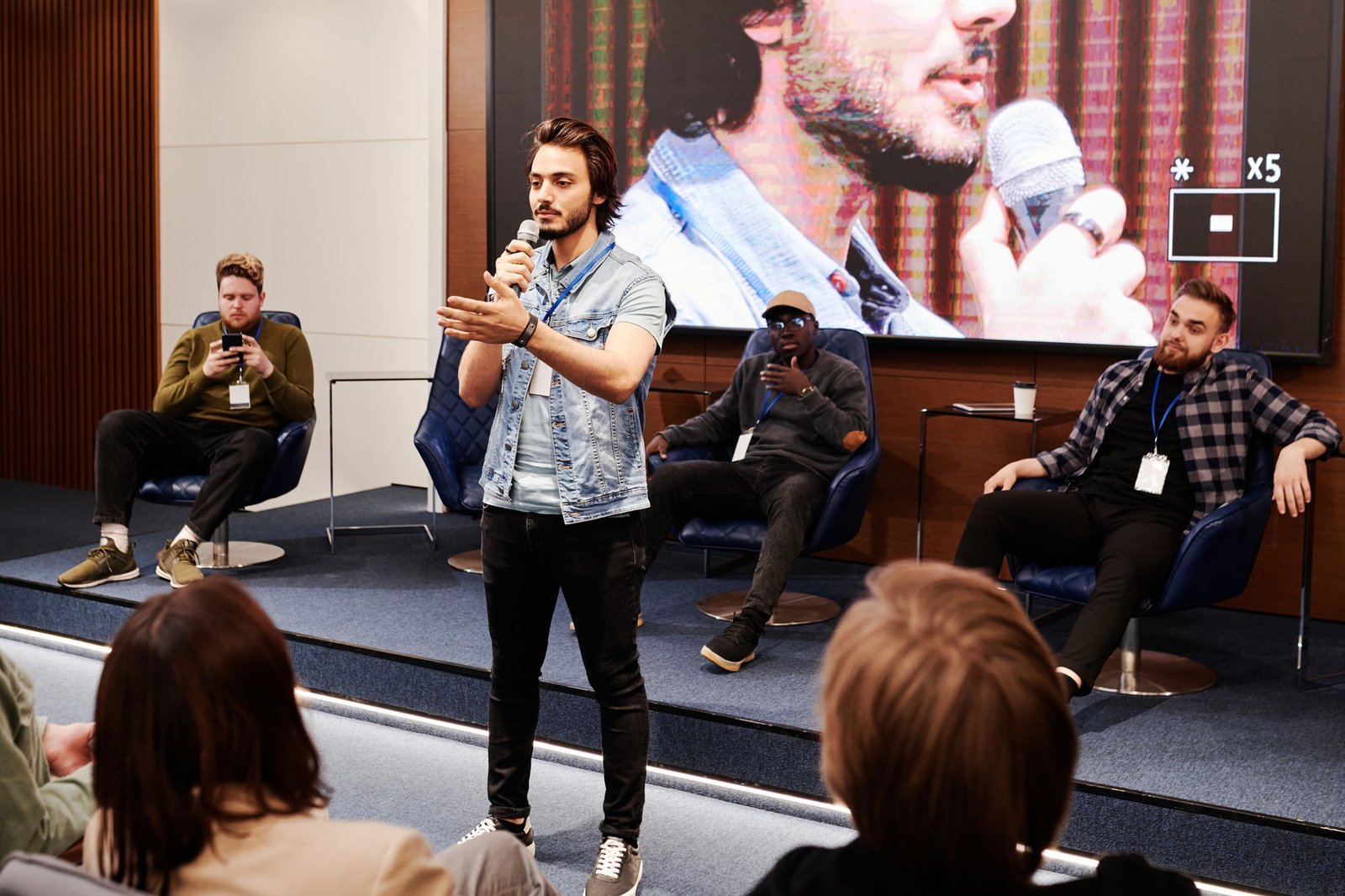


You check your analytics and the numbers look encouraging. Two hundred visitors last month. Some of them even spent real time on your speaking topics page. And yet your inbox stays quiet. No inquiries, no discovery calls, nothing that turns into an actual conversation about an event.
This is one of the most common and most misdiagnosed problems a speaker website has. The instinct is almost always to chase more traffic: another guest podcast, another round of SEO, another LinkedIn push. But sending more visitors to a page that already fails to convert the ones it has just makes the same problem more expensive. Traffic and inquiries are two separate problems, and when traffic exists but inquiries do not, the website itself is almost always where the answer lives.
This post walks through why this gap happens on speaker websites specifically, and the exact fixes that close it.
2-3%
is the average website conversion rate across industries. Many small business sites convert far below that
50ms
is roughly how quickly a visitor forms a trust judgment about your homepage
15-34%
higher conversion when trust signals like testimonials sit near the call to action
Why this is a conversion problem, not a traffic problem
If a speaker website is getting relevant visitors but almost nobody inquires, the honest first move is not more SEO or more social posting. It is figuring out what happens between the moment someone lands on the page and the moment they leave without clicking anything. Traffic tells you people are finding you. Conversion tells you whether the site actually persuades them once they arrive, and those are two entirely different problems with two entirely different fixes.
Most speaker websites do not have one catastrophic flaw sinking every inquiry. They have several small ones stacking on top of each other: a homepage that takes too long to explain what the speaker actually does, a call to action buried at the bottom of the page, a mobile experience that quietly breaks the one moment an organizer was ready to act. Individually each issue looks minor. Together they are the entire reason traffic and inquiries stop matching up.

The six most common reasons speaker websites leak inquiries

Fix conversion before you spend on more traffic
Here is the practical math worth sitting with. A site with 500 monthly visitors converting at 1 percent produces 5 inquiries. The same site improved to convert at 3 percent produces 15 inquiries from the exact same traffic, at zero additional cost for reach. Chasing more visitors before fixing conversion is buying more of a leaky bucket instead of patching the hole.
Most conversion problems on a speaker website do not require a full rebuild. They require a focused pass through the six issues above: a clear headline, one dominant call to action, a mobile experience that actually works under pressure, content aligned to buyer-intent searches, organizer-level proof near the decision point, and a form short enough that interest survives it. A full redesign becomes the right call when the underlying structure itself is the problem, for example when there are no individual topic pages to send qualified traffic to in the first place, a gap covered in our guide on keynote topic pages that get you booked.
Diagnose your own gap in five minutes
- Open Google Search Console and check whether your top pages rank for topic-specific searches or broad general ones
- Load your homepage on your phone using mobile data and time how long it takes to reach something tappable
- Count how many different calls to action compete for attention on your homepage
- Check whether an organizer testimonial sits near your contact form, or whether your only proof is buried elsewhere
- Count the fields on your inquiry form. More than five is worth reconsidering
Why is my website getting traffic but no inquiries?
Traffic without inquiries is almost always a conversion problem rather than a traffic problem. Common causes include a homepage that does not clearly state who you help and how, a call to action that is missing, buried, or competing with too many other options, a mobile experience that breaks at the moment an organizer is ready to act, traffic arriving from broad informational searches rather than buyer-intent ones, missing proof near the decision point, and inquiry forms that ask for more information than a first message requires. Fixing these issues typically produces faster results than adding more traffic to a page that already fails to convert the visitors it has.
Should I redesign my whole website or fix specific pages?
Targeted fixes are usually the right first move. Rewriting a headline, clarifying a call to action, shortening a form, and adding proof near the decision point can often be done page by page without a full rebuild. A complete redesign becomes necessary when the underlying structure is the actual limitation, for example when there is no individual page per keynote topic to direct qualified traffic toward, or when the technical foundation itself is too slow or outdated to fix incrementally. Start with your highest-traffic pages, measure the impact of small changes, and only commit to a full rebuild if the structure is truly holding you back.
What is a good conversion rate for a speaker website?
Average website conversion rates across industries sit around 2 to 3 percent, with many small business and personal websites converting well below that. There is no single benchmark for speaker websites specifically since it depends heavily on traffic quality and what counts as a conversion, whether that is a completed inquiry form, a booked call, or a media kit download. The more useful approach is comparing your own site against its own baseline over time, segmenting traffic by source, and tracking whether conversion improves after each specific fix rather than chasing an industry-wide number.
Does more website traffic help if my conversion rate is low?
Rarely, and it can make the underlying problem more expensive. Sending more visitors to a page that already fails to convert the traffic it has simply produces more visitors who leave without inquiring. A site converting 1,000 visitors at 1 percent produces 10 inquiries. The same site improved to 3 percent produces 30 inquiries from identical traffic at no additional cost for reach. In almost every case, fixing conversion issues on the pages you already have produces faster and more cost-effective results than growing traffic to a page that is not yet ready to convert it.
Let us find out where your inquiries are leaking
StageNexa builds and audits speaker websites specifically for this gap: clear headlines, focused calls to action, real mobile performance, and forms organizers actually finish. Book a free call and we will walk through your site together and show you exactly where visitors are leaving before they inquire.