
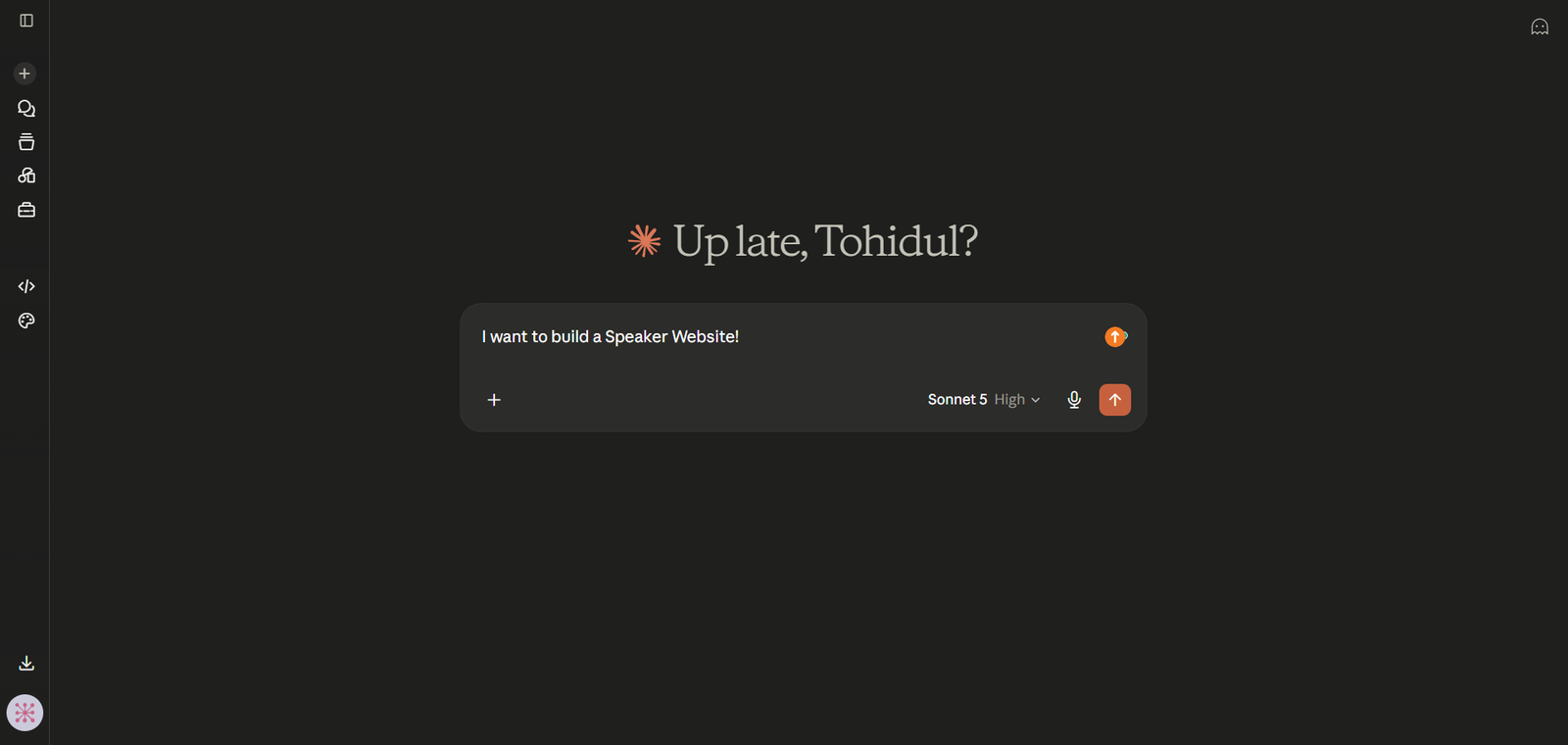
Let’s start with what is actually true, because pretending otherwise helps nobody. Claude, Gemini, and Lovable can build a real, working website in minutes. You describe what you want in plain English, and a functioning site with pages, forms, and design comes back before you have finished your coffee. That is not marketing hype. It is a genuine, working capability in 2026.
So the honest question is not whether these tools can build a website. They can. The honest question is whether the website they build is the same kind of asset a speaking business actually needs, one that has to convert a skeptical organizer into a booked stage, hold up for years, and be handed off, edited, and extended without asking anyone’s permission. That is a different question, and the answer to it is more specific than either side of this debate usually admits.
This post looks at what these AI builders are truly good at, where the real limitations show up in practice, and why WordPress remains the platform speakers land on once they understand the difference.
45%
of AI-generated code has been found to introduce security vulnerabilities, per Veracode’s 2026 research
70%
of an app is what AI tools reliably finish fast. The remaining 30%, the hard part, stays just as hard
43%
of the entire internet runs on WordPress, a platform with two decades of stability behind it
What AI website builders are truly good at
Credit where it’s due. Tools like Lovable generate a working site with a database, forms, and design in a single conversation, and platforms built on Claude and Gemini can reason through structure and content with real sophistication. For a rough prototype, a placeholder page while you are between things, or a way to test whether an idea holds up before committing real time to it, these tools do exactly what they promise, and they do it fast.
A web agency that spent 2026 testing these tools directly against real client briefs put it plainly after building with Lovable, Claude Code, and similar platforms on actual projects: they work well for a quick low-effort site, a single page with services and a contact form, nothing more, where the investment is low and nobody is depending on the site to convert visitors into customers. That is an honest, fair assessment, and it matters because it draws the exact line that this whole question turns on.

What actually shows up once a speaker depends on the site
A speaker website is not a placeholder. It is the asset an organizer researches before deciding whether to book you, and it needs to keep working for years, not weeks. Four specific things change once that is true.

Why WordPress specifically holds up for a speaking business
WordPress is not a competitor trying to out-hype these AI tools. It is the platform that has quietly powered 43 percent of the entire internet for two decades, through every previous wave of website builders that promised to replace it. That track record exists because of a few specific things a speaker actually needs.
Full ownership is the biggest one. Your site, your database, your content, on hosting you choose, movable to any provider at any time. Nobody’s business model or funding round determines whether your speaker website still works next year. Alongside that sits an enormous plugin ecosystem, tens of thousands of tools built for exactly the specific needs a speaker has: booking calendar integration, email marketing connections, WooCommerce for a book or course store, security hardening, and SEO plugins that structure content the way our guide on AEO vs SEO for speakers describes. An AI builder’s closed backend cannot match that breadth because it was never designed as an open ecosystem for others to build on.
There is also a simpler point underneath all of this. A speaker website’s only job is to convert an organizer’s interest into a booking. As covered in our guide on what pages a keynote speaker website actually needs, that requires individual topic pages, a media kit, and a structure built around how organizers evaluate speakers specifically, not generic business website features. That is knowledge about an industry, not a coding task, and it is exactly the part no AI prompt can supply on its own no matter which model is behind it.
Ask these before choosing either option
- Will this site still need to exist and convert bookings in three years, or is it a short-term test?
- If the platform changed its pricing or shut down tomorrow, could you actually take your site elsewhere?
- Does the build include individual keynote topic pages, a media kit, and organizer-focused structure, or a generic template?
- Who is responsible for the security of the forms collecting an organizer’s contact details?
Can I build my speaker website with Claude, Gemini, or Lovable instead of WordPress?
You can generate a working site with these tools, and for a quick placeholder or a way to test an idea, they do that job well. For a professional speaker website that needs to convert organizers into bookings over years, the practical limitations become significant: heavy vendor lock-in despite advertised code export, credit-based costs that scale poorly for ongoing edits, and a documented gap in the production-grade details, security, edge cases, and industry-specific structure, that these tools consistently struggle to finish. A speaker website depends on exactly the details that fall into that gap.
Is AI-generated code from tools like Lovable secure?
Independent research from Veracode found that 45 percent of AI-generated code introduces security vulnerabilities. A documented 2026 vulnerability in Lovable-built applications, caused by missing basic database access controls, exposed data across more than 18,000 users and 170-plus apps. This does not mean every AI-generated site is insecure, but it means security cannot be assumed, and for a site collecting an organizer’s contact and event details, that risk deserves real consideration rather than being an afterthought.
What is the vendor lock-in risk with AI website builders?
Platforms like Lovable advertise code export through GitHub, but independent reviewers who have tested this in practice describe the underlying architecture as a forked backend and captive runtime where the exported code does not realistically run on any other platform. There is no standard database or hosting environment to move to elsewhere. WordPress avoids this by design: the code, the content, and the database are all standard and portable, movable to any hosting provider without a rebuild.
Why do speakers still choose WordPress over AI website builders?
Speakers choose WordPress because a speaker website is a long-term business asset, not a short-term prototype. WordPress offers full ownership of the code and hosting, a plugin ecosystem built for exactly the tools a speaker needs such as booking integrations and email marketing, and two decades of platform stability that has outlasted every previous wave of website builders. Most importantly, the specific structure that gets a speaker booked, individual topic pages, a media kit, and organizer-focused content, comes from industry knowledge that no AI prompt supplies on its own, regardless of which platform builds the site.
Build the asset your speaking business actually needs
Every StageNexa speaker website is built on WordPress, structured around your keynote topics, your media kit, and how organizers actually evaluate and book. Book a free call and we will show you exactly what that structure looks like for your specific topics and audience.